Removing a Tree Near Power Lines
A tree near power lines must be assessed with the electricity network operator before removal begins. Do not cut, climb or pull branches away from wires yourself. Falling branches, equipment and electricity arcing across a gap can all create danger; direct contact is not required for a serious injury.
If a tree is touching damaged or fallen wires, keep people away and call 105. Call 999 when there is immediate danger to life. Electrical safety must be established before tree work proceeds.
The 10-metre planning trigger
HSE tree-work guidance requires specialist advice for proposed work within 10 metres of overhead lines, measured horizontally at ground level from below the nearest wire. Work farther away is also covered if falling trees, debris or equipment could breach that distance. This is a planning trigger, not permission for a householder to work at a particular distance.
A tall tree can affect a line even when its trunk is outside that area. Assess the whole tree, likely movement, lifting equipment and access. Underground cables must also be considered where stump removal or machinery is proposed.
Contact the line owner before fixing a date
The distribution network operator manages the local electricity network and is usually different from the company sending the electricity bill. Provide the location, a description and photographs taken from a safe position. Never approach a wire to get a better photograph.
The contractor and network operator must agree electrical controls and the time needed. An outage may require advance planning and notice to neighbouring customers. Do not assume that a line can be switched off immediately or that the network will pay for all tree removal.
What the coordinated work plan includes
Identify the apparatus, work limits, access routes, exclusion arrangements and responsibility for electrical safety. The plan should explain the removal method and what happens if conditions change.
A confined site may require controlled dismantling rather than whole-tree felling. That choice does not remove the electrical hazard: ropes, suspended timber, cranes, lighting towers and platforms all need assessment. Work should stop if the agreed electrical conditions cannot be maintained.
Why a power cut does not prove a wire is safe
HSE overhead-line advice warns against relying on gloves, rubber boots or apparent insulation. A circuit can re-energise automatically after tripping. Quiet wires and a neighbourhood power cut are not evidence that a line is dead.
Only the line owner's authorised arrangements can establish the electrical conditions for the job. The tree owner's permission is separate and cannot replace that process.
Recent safety statistics and a relevant incident
HSE figures released in July 2026 provisionally record 126 worker fatalities in Great Britain in 2025–26, including 22 in agriculture, forestry and fishing. These broad figures are not a count of electrical tree-removal incidents.
A May 2026 HSE prosecution report describes a January 2024 vegetation-work incident involving a lighting tower and an 11,000-volt line. Ground equipment needs the same planning attention as climbing and cutting.
When a tree has already fallen onto a wire
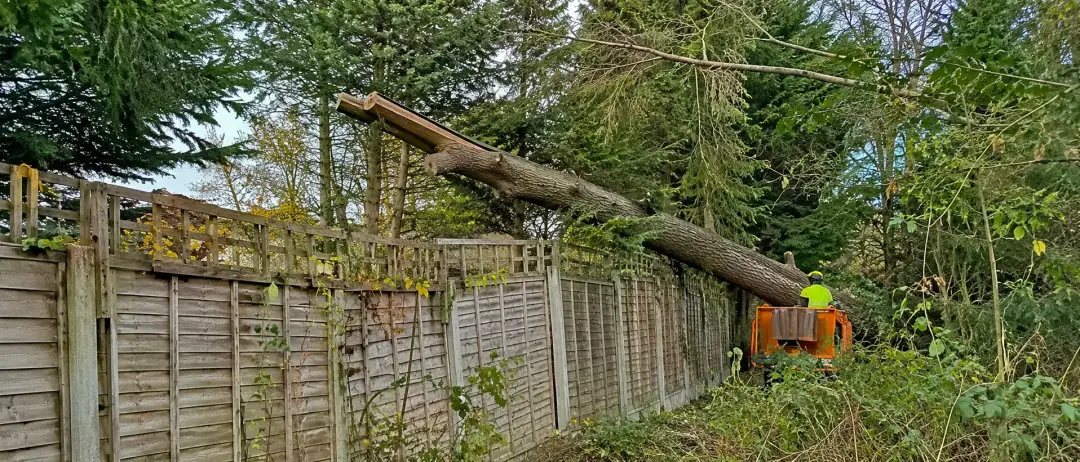
Stay away from the tree, wires and objects potentially connected to them. UK Power Networks' emergency advice says to keep at least 10 metres from damaged equipment and call 105; follow the network's instructions on greater separation. Do not disentangle branches or touch anyone in contact with electrical apparatus.
Give responders the location from a safe place. Once the electrical hazard is addressed, the remaining tree damage can be assessed and removal arranged.
Summary
Power-line tree removal starts with the network operator and a coordinated safety plan. For immediate electrical danger, call 105 or 999 as appropriate. After the electrical hazard has been addressed, Blackdown Treescapes can discuss the remaining tree-removal work.