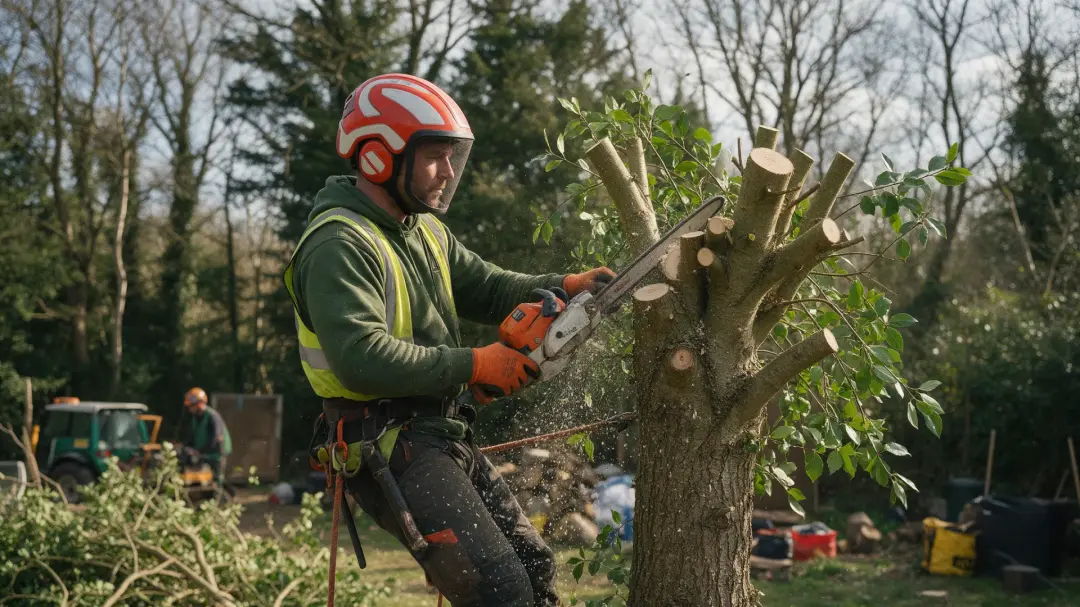
How Often Should Pollarded Trees Be Pruned?
Pollarded trees need a recorded pruning cycle, often annual but sometimes extending over several years. Base the next visit on the established regime and the condition of the regrowth. There is no universal rule that every pollard can be left for the same period.
The practical task is to turn an assessment into a maintenance plan: record the work, set a review date and define what should prompt an earlier visit.
What current management programmes show
Enfield Council's current schedule aims to pollard its street planes and limes every four years, covering a quarter of them each year. This is a real programme figure checked in October 2026, not a national frequency for private trees.
The RHS maintenance guidance describes annual cutting as common. An ornamental tree maintained within tight dimensions and a street tree with a wider management envelope need not share the same interval. Ask why the proposed cycle suits your tree rather than copying a council timetable.
Keep a record for each tree
Record the species, location, last cutting date, retained heads and defects observed. Dated photographs from safe ground positions help the next contractor understand the starting point. Keep the written specification with the invoice rather than relying on a recollection of how much was removed.
For several trees, give each a simple number. A row of similar-looking trees may have different growth rates or pruning histories. Distinguish those due for cutting from those needing only inspection or further investigation.
Inspection and cutting are different appointments
A tree not yet due for pruning may still require assessment after a storm, a broken branch or a change in the use of the land beneath it. A new play area or busy access route changes the consequences of failure.
From the ground, note cracks, damaged regrowth or unusually sparse foliage. Report changes rather than climbing to investigate. A calendar reminder is useful, but should not prevent an earlier visit when circumstances change.
Respond carefully to a missed cycle
A missed date is not proof that a tree is unsafe. Nor is it a reason to make an automatic heavy cut. Review the size and attachment of the regrowth and whether the previous method is still appropriate.
Large stems may require retained branches or phased intervention. Ask the arborist to distinguish routine pruning from restoration and explain what will remain. Do not assume returning to all original heads is harmless after years of uninterrupted growth.
Choose the seasonal window too
Agree the preferred season when the programme is written. Many deciduous pollards are worked during dormancy, but species, weather, tree health and wildlife can change the appropriate window. Let the visit move when conditions make it unsuitable.
Government bird-protection guidance protects nests in use or being built. A winter booking does not remove the need for checks. Other protected species may also require surveys or restrictions before cutting starts.
Budget for access and retained growth
Repeat work can involve traffic arrangements, access permissions, lowering equipment and disposal, alongside cutting. Agree whether wood or chips will stay and where they will go. Predictable access arrangements make the cycle easier to sustain.
Where suitable trees are managed as a group, ask whether a rotation can retain some canopy each year. That is a site-specific choice, not a justification for delaying a tree whose condition needs earlier attention.
Finish each visit with a next-step plan
The handover should state what was completed, any change to the specification and the reason for the next inspection or pruning date. It should name observations that require an earlier call.
If you want to stop pollarding, request a transition assessment. Allowing every shoot to develop indefinitely changes the managed structure and loads. Cancelling appointments is not itself a restoration method.
Summary
A useful pollarding programme combines a cutting record, condition reviews and a justified next visit. Blackdown Treescapes can help set a schedule that responds to regrowth, missed cycles and changes around the tree.